
Webflow Expert
Website Design
Hiring a Webflow Developer
.png)
You're ready to hire for your Webflow project, then the job titles start blurring. Designer, developer, expert, specialist. They sound like different people doing different jobs, and it's not obvious which one your site actually needs. Hire the wrong one and you either overpay or end up with gaps.
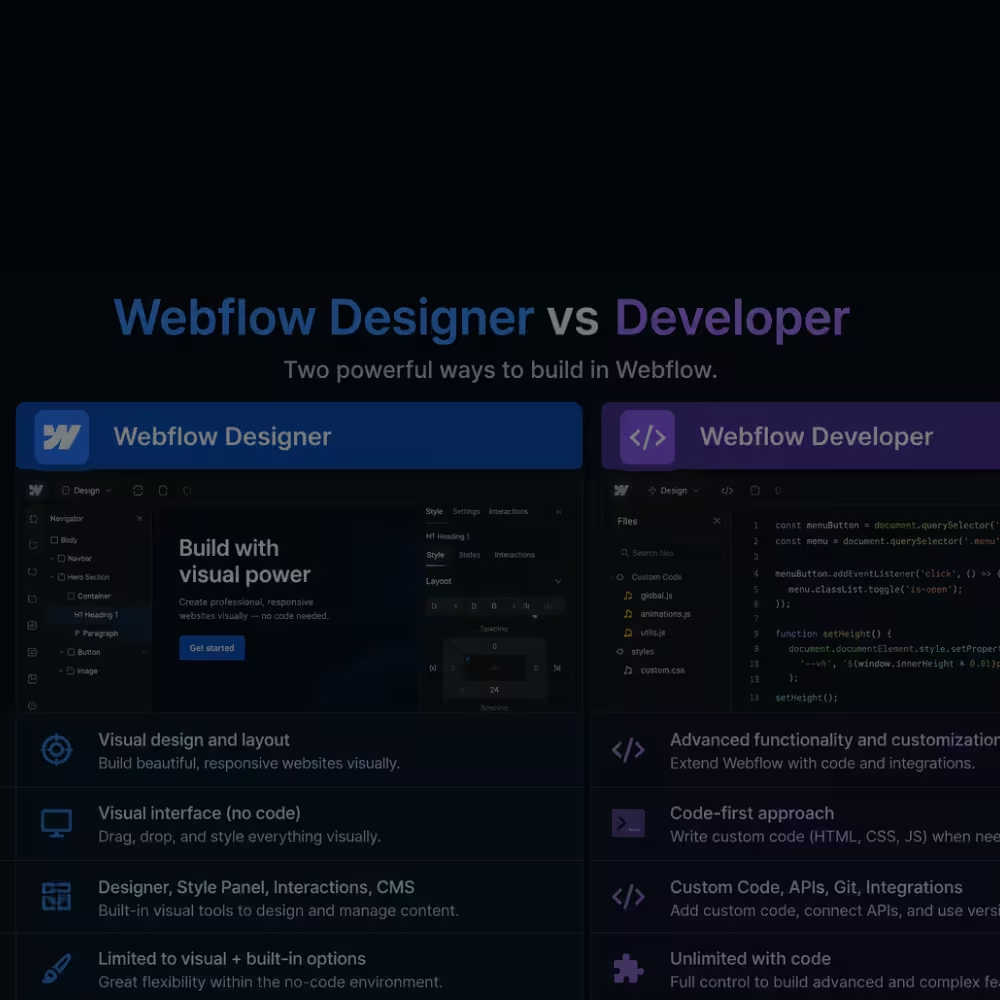
Here's the short version. A Webflow designer decides how the site looks. A Webflow developer decides how it's built. A Webflow expert does both to a professional standard, in one place, using a structured framework. For most business websites, the expert is the role you want, because in Webflow design and build are so tightly linked that splitting them adds cost and friction without adding quality.
I'm a Webflow specialist who designs and builds in one workflow, using Client-First from Finsweet and Webflow CMS. So I've seen both the split-role approach and the single-expert approach up close. Here's how to tell which one fits your project.
A Webflow designer owns the visual side: layout, colour, typography, spacing, and the overall look and feel. On some teams they work in a design tool first and hand the visuals over to be built. Their strength is aesthetics and brand. Their limit is that a beautiful design still has to be built well to actually perform, and a designer who does not build cannot guarantee that.
A Webflow developer owns the build: clean structure, responsive behaviour across devices, Webflow CMS setup, custom interactions, and performance. This is where a site is made maintainable or left a mess. A strong developer names conventions, reuses classes, and structures content so the site scales. The limit is the reverse of the designer's: raw build skill without design judgement can produce a fast site that looks flat.
Because in Webflow, design and build are the same act. You design by building. When one specialist owns both, the visual intent survives all the way to the live site, there's no handover where things get lost, and the structure supports the design rather than fighting it. That's why I build the way I do, and why a Webflow specialist compared to a general web developer tends to deliver a more coherent result. You get one point of contact, one bill, and one person accountable for how the site looks and how it performs.
There are cases for it. A large organisation with a dedicated brand team may want a specialist designer shaping the visuals and a specialist developer building them at scale. A highly custom product with complex functionality can justify deep specialisation on each side. But for a standard business, marketing, or content-driven site, splitting the roles adds cost, adds a handover, and rarely improves the outcome. One expert is usually faster and better.
Match the role to the scope. If you need a full site designed, built, and handed over ready to manage, hire a Webflow expert who does both. Ask to see live sites you can test, ask which framework they build on, and ask how they'll structure your content in Webflow CMS so your team can update it. You can also cross-check specialists against Webflow's official expert directory and confirm build standards against Finsweet's Client-First guide. Clear answers point to a specialist; vague ones point to a dabbler.
Usually, yes, and for two reasons. First, you're paying one person instead of two, with no duplicated project management or overlapping hours. Second, and less obvious, you avoid the cost of the handover itself. When a designer passes work to a separate developer, something is always lost in translation, and reconciling the two often eats hours nobody quoted for.
A single specialist absorbs the design and build into one continuous workflow, so there's no gap to pay for. For most business sites that means a lower total cost and a more coherent result. The split-role approach earns its extra cost only when the project is large enough that deep specialisation on each side genuinely pays off, which is rarer than it sounds.
What is the difference between a Webflow designer and a Webflow developer?
A Webflow designer focuses on how the site looks: layout, colour, typography, and visual hierarchy. A Webflow developer focuses on how it's built: structure, responsiveness, CMS, interactions, and performance. In Webflow the two overlap heavily, which is why many projects are better served by one person who does both.
What is a Webflow expert then?
A Webflow expert combines both roles. They design and build to a professional standard in one place, using a structured framework so the site is maintainable. For most business sites, this is the role you actually want rather than splitting the work in two.
Do I need both a designer and a developer for a Webflow site?
Usually not. Splitting the roles adds cost and handover friction. A single Webflow specialist who designs and builds keeps the vision intact and the project faster, which suits the vast majority of business websites.
When should I hire separate roles?
On large or highly custom projects with a dedicated brand team, a specialist designer and a specialist developer can make sense. For a standard business or marketing site, one expert is more efficient and usually higher quality.
Does a Webflow expert handle the CMS and SEO too?
Yes. A genuine expert sets up Webflow CMS so you can manage content yourself and builds on-page SEO in from the start. Those should not be separate line items you commission later.
For most sites, the designer versus developer question has a simple answer: hire a Webflow expert who does both. You keep the vision intact, cut the handover friction, and get one person accountable for the whole result.
If you want a Webflow specialist to design and build your next site end to end, book a free consultation and we'll work out exactly what your project needs.
Practica tips and web strategy delivered straight to your inbox. No spam, just useful content.
.avif)